The Starling and the Falcon
Team dysfunction in IT can trace back to two very different instincts about how to handle uncertainty. Remembering two types of birds can help.
Unlike The Scorpion and the Frog or the Tortoise and the Hare, which are parables used to impart truths or prompt reflection, this framing is merely intended to identify common patterns of behavior. These behaviors are best understood within the frame of fundamental attribution error, which essentially says that behaviors are much more about the environment than the traits of individuals.
There are many more types of birds in the aviary than these two. You might relate to one, both, or neither of them depending on the context.
The Starling
On one end of the spectrum is the starling. It's a small bird best known for flying in flocks, and their fluid, chaotic movements in such large numbers can be mesmerizing.

The IT starling follows their flock.
On the positive side, they tend to be good collaborators and don't hesitate to ask for help when they need it. They’re strong at alignment, knowledge-sharing, and keeping work moving under ambiguity. They are the ones going to conferences and hosting lunch-and-learns. They understand that personal growth is usually much easier with social accountability.
On the negative side, they tend to follow industry trends without validation and prioritize their career over stakeholder outcomes. They may be early adopters primarily for relevance and less so for intellectual curiosity or concrete outcomes.
This behavior emerges from feelings of loss aversion and career uncertainty, but is taken to the extreme in IT due to the pace of change. Maybe they were laid off early in their career. Maybe they were passed over for a job because they did not have 7+ years of experience for a technology that came out 2 years ago. It's easy to relate to them once you understand that IT often has much more in common with the fashion industry than mechanical engineering.
Starlings are prevalent in IT. They can do great things and play nicely with others, but can also leave a lot to clean up after.
If you are leading a team heavy with starlings, consider:
- Fostering a culture focused on long-term sustainability and purpose to reduce background anxiety levels
- Ensuring slack in processes so that the team can learn new skills in a safe, experimental way instead of in production
- Establishing guardrails around major system changes, such as "no more than two ways of doing something at any given time" (the current way and the one new way being explored)
The Falcon
On the opposite side of the spectrum is the falcon. Falcons are powerful raptors with eyesight we humans would struggle to imagine: 100 Hz (a high frame rate), high-resolution, and ultraviolet.
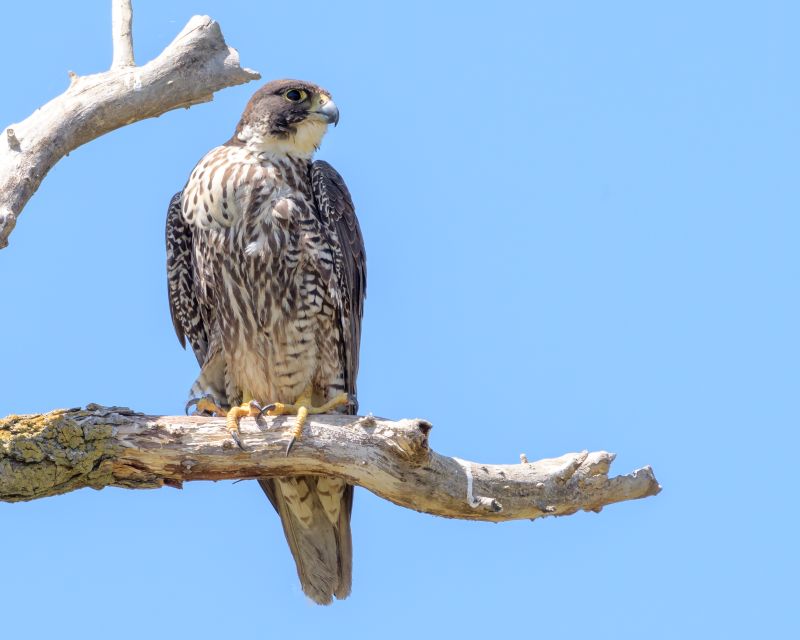
The IT falcon is a highly effective, territorial, and solitary hunter.
On the positive side, they tend to be (or seem to be) the most productive people in the organization. They are genuinely passionate about their work, are willing to sacrifice, and are often driven to apply their hard-learned lessons to make progress and minimize waste. They have pride in craftsmanship and focus on the details when nobody is looking.
On the negative side, they may struggle to collaborate or delegate, especially when their design choices are challenged. Their bias for control tends to come from professional successes, failures, or trauma. Falcons that have become indispensable can face terrible stress and struggle to find coping mechanisms.
Falcons are fewer than starlings but certainly exist in every IT organization. They tend to be created in situations where "the business" and IT are not aligned, as described in The Phoenix Project where a singular hero became a liability.
Falcons may also ruin team dynamics, hoard information, and quickly become a bottleneck. Like starlings, falcons can also leave behind a (different kind of) mess.
If you are leading a team with one or more falcons, your focus should be on:
- Mitigating risks through pairing, documentation, automation, and rotation of responsibilities
- Formalizing how creative work and design decisions are made in a team setting, such as RFCs, to encourage collaboration
- Providing a larger variety of growth opportunities: mentorship, postmortems, transformations, special interest groups
Takeaways for Individual Contributors and Managers
It's possible to find yourself or your people on either side of this spectrum over the course of your career. You may also encounter starlings who are territorial about their stuff and falcons who are exceedingly friendly, agreeable, and helpful. Neither side is right or wrong; they are just extreme opposites in how to cope with two life challenges:
- When making difficult decisions, starlings rely more on external authority whereas falcons look inward.
- When dealing with uncertainty, starlings seek safety and falcons try to exert control.
Once you recognize the patterns, try to take the best parts from both and avoid the downsides:
- Selectively follow "best practices" and don't overvalue prior experiences.
- When approaching difficult decisions and uncertainty, be collaborative but don't outsource your own judgment.
- Provide enough slack and safety to allow for learning and teaming.
The goal is not to eliminate starlings or falcons, but to build a team healthy enough to keep either extreme from running the aviary.